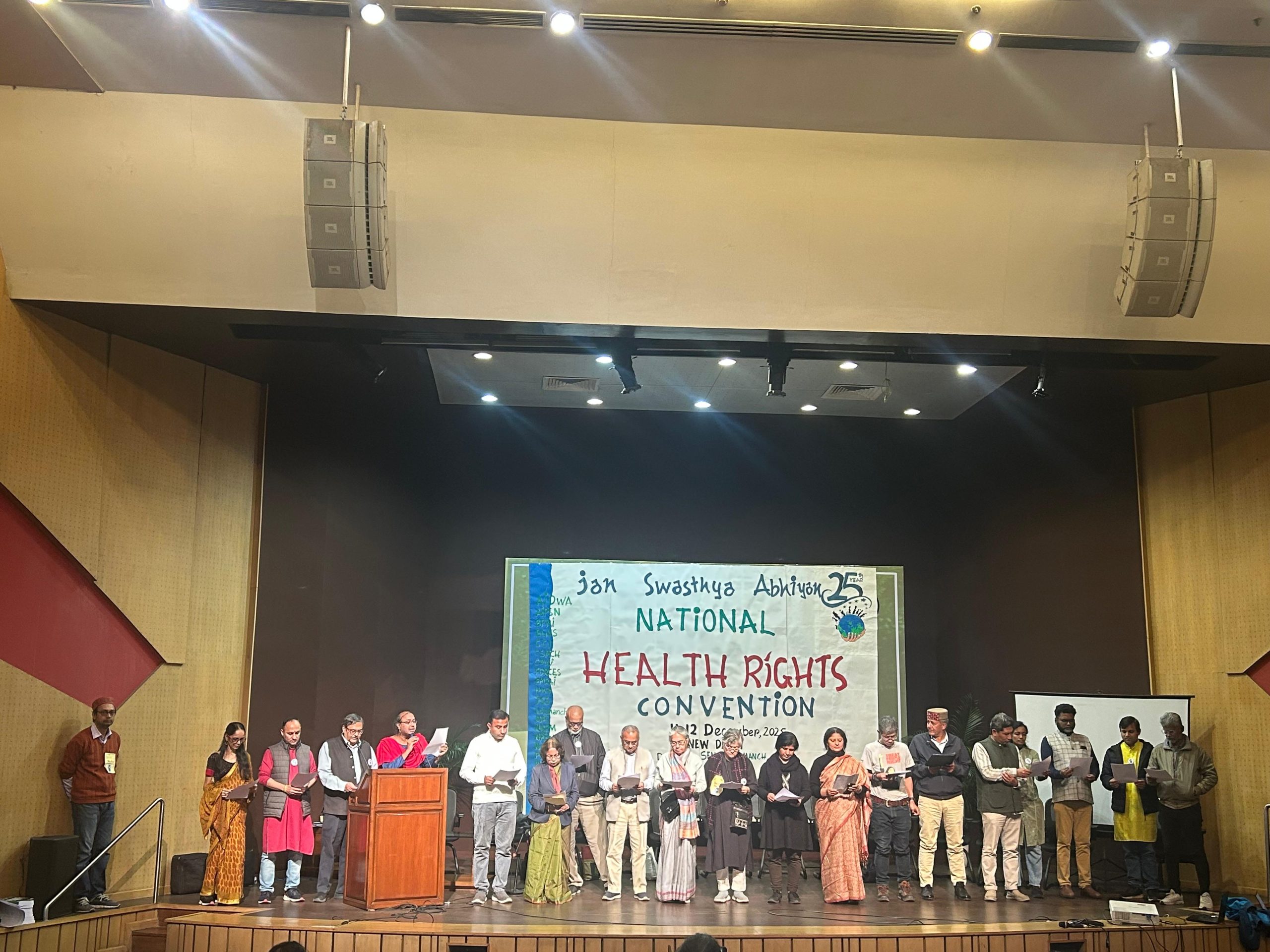
Jan Swasthya Abhiyan: People’s Manifesto on Right to Health and Healthcare - 2024
Addressing the health system crisis - Urgent need to advance people’s
Right to health and healthcare through transformation of health systems
As India approaches the 2024 Lok Sabha elections, Jan Swasthya Abhiyan circulates this memorandum with
a charter of policy proposals, appealing to all the political parties and independents in the election fray to
commit to these by incorporating them in their election manifesto. This is essential because of the critical
state of our country's health system, since more than 80 crore people of this country who today depend on
free ration also require protection for their health-related vulnerabilities. Despite the COVID experience,
people’s health still remains very low on priority for the Union government. Increasing commercialisation
and decrease in the government’s role has placed quality healthcare out of reach of the majority of Indians.
The Union government's handling of the COVID pandemic was marked by serious mismanagement on
various fronts, exacerbating an already critical situation. Although the pandemic underlined the
outstanding need for stronger public health systems, the Union government’s spending on health remains
dismal. It continues to restrict funds, along with neglecting the National Health Mission, while eroding
federalism and imposing hyper-centralised decision making. Refusal to regulate profiteering by the
commercialised private healthcare sector, accelerated privatisation of health services, and failures of the
much-hyped PMJAY health insurance scheme have further worsened the situation, leaving the vast majority
of the population, especially marginalised communities at risk.
Key Policy Proposals Concerning Right to Health and Healthcare
1. Our Health, Our Right! - Right to Healthcare legislation must be passed to ensure guaranteed
availability of free quality treatment of all conditions, in close proximity to place of residence.
Expand, improve & strengthen public healthcare infrastructure to provide such essential care.
Denial, delay and incomplete treatment to be strictly prevented.
2. Increase Budgetary Allocation for Health – Increase Health Spending to 3.5% of GDP, with 1% of
GDP coming from Centre; States should get special financial envelopes for raised health
expenditure.
3. No one should face financial hardship due to Out-of-Pocket (OOP) Spending on health – Reduce
OOP to less than 25% of Total Health Expenditure.
4. Fill Vacant Posts and Ensure Justice to Health workers – No health facility should have a vacant
position. No public health establishment should engage contractual staff, it is essential to
regularise all scheme based and contractual health workers. Ensure adequate wages and
protection under labour laws. A Human resources for health policy would be enforced to ensure
these measures.
5. Devolve administrative and financial powers to local bodies and state governments to enable
them to conceptualise and manage health systems in their jurisdictions, with support from
national and regional bodies.
6. Immediately reverse the rebranding of Health and Wellness Centres as ‘Arogya mandirs’, in
keeping with the constitutional values of secularism and inclusivity.
7. Ensure availability of affordable and quality essential drugs & diagnostics – Implement effective
and rational price control; return to cost-based pricing. Ensure availability of medicines as per
the NLEM 2022, eliminate all irrational medicines and Fixed Dose Combinations (FDCs). 8. Healthcare is primarily the government’s responsibility – Phase out Government-funded health
insurance schemes such as PMJAY and Public Private Partnerships.
9. Regulate Private healthcare sector by ensuring effective implementation of an improved Clinical
Establishment Act. All states must ensure effective regulation of private healthcare while
implementing the Patients Rights Charter, along with transparency and regulation of rates, and
grievance redressal systems for patients.
10. Stop Commercialisation of Medical Education – Review & reform National Medical Commission
and National Eligibility cum Entrance Test (NEET). Ensure highest standard of medical, nursing
and other allied medical services education and one common uniform system of admissions and
fee structures
11. Protect Workers’ Health – Properly implement National Policy on Safety, Health and
Environment at Work. Ensure effective implementation of laws and related measures to prevent
serious diseases like silicosis caused due to hazardous occupations, ensure full rehabilitation of
families affected by ailments. Strengthen, reform and expand the ESI system.
12. A public-centred system for universal health care, ensuring a common system to provide health
care for all residents of India, must be developed in the foreseeable future.
Jan Swasthya Abhiyan proposes the following range of policy actions in the health sector, which
should be committed to by all political parties and candidates in context of upcoming Lok Sabha elections.
JSA will mobilize and campaign among different sections of the people around these proposals, and call
upon all social movements, civil society organisations and people to build a consensus around these
actions, which must become the highest political priority in India today.
I. Make the Right to healthcare a justiciable right through the enactment of appropriate legislations
at Union and State levels. Retain health services as a state subject with strong emphasis on
federalism
There is a need to ensure all-encompassing healthcare access from primary to tertiary services, for the
entire population by enacting Right to healthcare legislations at State level. This should be supported by
an appropriate legal, financial and operational framework at national level. In a complementary manner,
public health laws must secure access to health determinants, protecting people’s health from various
influences. The overall direction should be to establish healthcare as a fundamental right in the Indian
Constitution. Health services should remain with the State List as enshrined in the Constitution and
should not be made part of the concurrent list.
II. Rapidly increase public expenditure on Healthcare to reach 3.5% of GDP, with at least 1% of GDP
being spent by the Union Government.
Overall public health expenditure must be majorly increased to reach 3.5% in the short term. While
enabling this, the Union government should transfer a much larger share of resources to states through
the Finance Commission (FC), and a special financial envelope for states should be created for
implementation of Right to Health and Healthcare under the XVI Finance Commission. Special grants
under XV FC to local bodies should be augmented further, to foster decentralised governance and delivery
of healthcare services. Allocation towards the National Health Mission should be enhanced to facilitate
upgradation and expansion of rural and urban health services, and dealing with communicable as well as
non-communicable diseases and climate related health challenges. Greater flexibility should be accorded
to states to decide on the priorities within NHM and the process of participatory, decentralised planning
should be strengthened. III. Out-of-pocket expenditure on health must be minimised and brought down to below 25% of
health spending in next five years
Out-of-pocket (OOP) spending on healthcare should be minimised so that no one is pushed into poverty,
or faces catastrophic health spending and indebtedness due to healthcare expenses. Current decline in
utilisation of health services due to high spending by households is unacceptable and must be reversed
to ensure that no one has to forgo healthcare due to unaffordable costs. The objective of reducing OOP to
less than 25% of health spending should be adopted as a national goal.
IV. Expand and strengthen the public healthcare system to ensure free availability of quality health
care at all levels, including entire range of medicines, diagnostics and vaccines
Strengthen and enable public health systems at all levels in rural and urban areas to provide free
comprehensive services, essential drugs and diagnostics, expanding both quantity and quality based on
health services standards. This would require upgradation of public health facilities, with matching
human resource policy and improved governance and management. Combined with this, it is important
to ensure nationwide access to essential medicines and diagnostics in all public facilities, based on
models of successful state level schemes such as those operating in Tamil Nadu, Kerala and Rajasthan.
Along with ensuring genuinely autonomous public corporations with adequate and competent staff and
various measures for transparency and responsiveness, public budgets on medicines must be
substantially upscaled to meet the requirements. The government must provide all essential medicines,
diagnostics, and medical devices, free of charge, in publicly run hospitals for life-threatening diseases, in
order to fulfill its constitutional obligations under Article 21. Ensure regular, adequate availability of
essential vaccines through the public health system.
V. Eliminate corruption, ensure community accountability and democratise the health system
It is essential to ensure transparency and social accountability while eradicating corruption in the Public
health system, based on processes for broad based participation and democratisation. Ensure
empowered participation of people through generalisation of community-based planning and
monitoring, with involvement of public representatives, people’s organizations, women's groups and
health sector CSOs at all levels from village to state. Develop a community-driven health system with
active, diversified participation and strong grievance redressal mechanisms.
VI. Replace Government funded health insurance schemes with a Public centred system for Universal
Health Care, eliminate PPPs and privatisation of health services
Phase out the Pradhan Mantri Jan Arogya Yojana - based on the discredited insurance model - in a phased
manner, and replace this with a Public centred system for Universal Health Care. In the interim, all
admissions under the scheme in private facilities must be based on gatekeeping by public health facilities,
regarding those conditions where services are not available within the public system. There is clear need
as well as potential to develop a public centred system for Universal Health Care, based on major
expansion and strengthening of public services, while engaging regulated private providers to address
current gaps. This system will provide ready access to quality healthcare, which will be available free of
charge to everyone. Eliminate existing PPPs which weaken public services, abolish privatization of
government health services, no government hospitals or services should be handed over to private
companies.
VII. Reverse the rebranding of Health and Wellness Centres as ‘Arogya mandirs’ Without any significant expansion in number of SCs and HWCs and augmenting the provision of services
in those facilities, the Union government has arbitrarily renamed these public institutions built over the
last several decades, as ‘Arogya mandirs’ with religious connotations. This is clearly a violation of
principles of secularism enshrined under the constitution, and must be immediately reversed. It must be
ensured that public institutions remain secular and inclusive, focusing on the overall well-being of all
citizens. Instead of making such negative and superficial changes, efforts should be made to substantially
strengthen and upgrade the Sub-centres and PHCs now designated as HWCs, to provide comprehensive
primary care.
VIII. Ensure justice for all health workers, upgrading and regulating training of health force
All scheme based and contractual health workers, including ASHAs and Anganwadi workers, must be
regularised while ensuring them adequate wages and protection under labour laws. The policy of
contractualisation must be replaced by systematic regularisation of all types of contractual employees in
health services. All vacancies in Health Departments must be filled and new posts created as per
requirement. All health workers including ANMs, Nurses, Doctors and Paramedics must be paid decent
wages while working in a supportive environment. There must be complete transparency in the processes
of recruitment, transfers and promotions of officers and employees in the health system. Increase public
investment in health professional education and training and regulate private institutions providing
training for healthcare personnel.
IX. Need for major reforms in medical education and National Medical Council
There is an urgent need to control commercialized private medical colleges, while not sanctioning further
such private colleges and mandating their fees to be not higher than government medical colleges. There
is need for independent, multi-stakeholder review and reform of the structure and functioning of the
National Medical Commission, which has come under major criticism for lack of representation of diverse
stakeholders, promoting high degree of centralisation in decision-making with erosion of state autonomy,
and promotion of further commercialisation of medical education. There is a particular need to review
and restructure the National Eligibility cum Entrance Test (NEET) which tends to place candidates from
rural areas, those from non-English medium schools and less privileged backgrounds at a disadvantage.
NEET encroaches on the autonomy of states in determining their own medical admission processes, and
the imposition of NEET is perceived as an infringement on state level educational policies.
X. Adopt a people-centred, rational pharmaceutical policy and make medicines affordable for all
A pro-people pharmaceutical policy must be implemented which would bring all essential medicines and
devices under effective and rational price control. The comprehensive price control regime should restore
cost-based pricing for all medicines, along with banning irrational drugs and combinations, regulating
pharma marketing practices, and promoting generic medicine outlets. It is important to implement a
comprehensive generic medicine policy, which covers labelling as well as prescribing of all medicines.
Resist dilution of Patent Law provisions that protect national interests and use public health safeguards
in the Indian Patent Act. Reject provisions being pushed through Free Trade Agreements which affect the
production of low-cost generic drugs. Utilize compulsory licensing provisions to reduce the costs of high-
cost treatments for diseases such as cancer and rare diseases. Additionally, address regulatory barriers
to the entry of costly biosimilar medicines. Monitor online medicine trade, and effectively promote fair-
priced drug outlets. Strengthen public pharmaceutical industries and public sector vaccine production units, while rolling
back their privatisation. Addressing Intellectual Property Rights (IPR) issues, coupled with scaling up
production through Indian public sector companies would enhance vaccine accessibility. Reinstate
funding for Open-Source Drug Discovery (OSDD) initiatives, promoting collaborative research for
affordable and accessible medications. It is also recommended to abolish GST imposed on sale of
medicines, as part of the wider spectrum of measures required to ensure affordability of medicines, which
are essential life-saving products.
XI. Protect workers health
Ensure health protection for all workers in unorganised as well as organised sectors. Formulate and
enforce a comprehensive occupational health and safety (OHS) policy, while integrating OHS into the
medical curriculum. Properly implement the National policy on safety, health and environment at work
(2009), adopt all ILO conventions concerning workers health and safety. It is important to integrate
occupational health services with general health services at all levels. Strictly implement laws and related
measures to prevent occupational diseases like silicosis and other occupational lung diseases. Ensure full
rehabilitation of families affected by these ailments as done in the instance of the Bonded Labour System
Abolition Act. Implement health impact assessments for all corporate projects, ensuring transparency
and participation. Majorly strengthen and reform the ESI system, expanding this system to provide
healthcare protection for all workers in both organized and unorganized sectors.
XII. Regulate the Private healthcare sector and safeguard patients’ rights
Effectively regulate the private healthcare sector by amending the Clinical Establishment Act-2010,
towards ensuring patient rights, quality of care, transparency and standardisation of rates. To check
irrational and unnecessary interventions, treatment practices need to be more standardised, with these
measures people will not have to pay huge bills in private hospitals. States should adopt such improved
regulation or should enact their own acts with similar positive provisions. It is important to establish
well-staffed, dedicated mechanisms for effective implementation of these regulations, which include
people’s representation. The complete 'Patient Rights Charter' must be strictly enforced in all hospitals
and health facilities, display of indicative rates will be mandatory and user-friendly grievance redressal
system should be operationalised. Rates for diagnostics also must be regulated, and “cut practice” should
be effectively banned. It is also important to implement a publicly managed admission system for
charitable hospital beds, so that referrals from government facilities to charitable trust hospitals can
optimize utilisation of beds for economically weaker sections.
XIII. Promote medical pluralism and AYUSH systems of healing
It is necessary to support medical pluralism so that people have a choice to access non-allopathic systems
of healing, including safe home-based birthing practices. Substantial encouragement and funds must be
given to research and documentation, to promote evidence-based use of AYUSH and traditional
community-based systems of healing. At the same time, certain commercialised Ayurvedic companies
have been found to make exaggerated health claims about their products, although these claims may not
be demonstrated. There have also been concerns about some Ayurvedic products related to quality
control and safety issues. Hence there is need for effective, appropriate regulatory oversight of Ayurvedic
and other AYUSH systems of medicine in context of growing commercialisation and certain kind of
political patronage to specific companies. XIV. Ensure gender sensitive health services and social support systems
Recognize gender-based violence as an important public health concern, providing prompt rescue,
comprehensive medical care, and sustained support. Address gender-based violence and harassment
concerning health workers urgently. Ensure equitable, quality healthcare for women, adolescents,
children, and LGBTQ individuals from all backgrounds, including those experiencing violence.
Universalize maternity benefits for all, including contractual and daily wage workers, and provide
workplace creche and restrooms for working mothers with small children.
XV. Ensure comprehensive healthcare for vulnerable groups and sections with special health needs,
eliminate all forms of discrimination and exclusion in health care
Implement special measures to provide comprehensive, quality health services for vulnerable
populations and those with special needs, addressing vulnerabilities related to social background, health
status, lifecycle position, occupation and other factors. This must address the health needs of women,
dalits, adivasis, Muslims and minority communities, particularly vulnerable tribal groups, LGBTQ
persons, refugee and migrant populations, people in conflict areas, people living with HIV, manual
scavengers, waste pickers, differently abled persons, children and elderly persons, and all other
vulnerable groups. Urgently eliminate all forms of discrimination including caste, community, religion,
tribe, or ethnicity-based discrimination in the health sector, while ensuring the right to healthcare for all
with dignity. Remove mandatory Aadhar linking for accessing health services, and ensure access to
healthcare for all without barriers based on state domicile, citizenship proof, etc.
XVI. Address mental health in comprehensive manner, upgrade disease control and preventive health
programmes
Ensure comprehensive treatment for mental health problems, community-oriented care and wider
promotion of mental health, through enhanced implementation of an expanded District Mental Health
Programme within the National Mental Health Policy framework. Address inadequacies in dealing with
major diseases, like HIV-AIDS and Tuberculosis through expanded and reoriented health programs.
Upgrade preventive health programmes and enhance mechanisms to handle communicable diseases
based on a review of current systems.
XVII. Regulation of clinical trials, promoting people-oriented health research
Implement strict regulation and fair compensation for clinical trial participants, which would be
effectively monitored by CDSCO. Develop a justiciable charter of rights for clinical trial participants.
Upgrade public health research capacity, while facilitating the use of findings to guide action and improve
health systems. Ensure effective regulation of conflicts of interest, ensure adequate national sources of
funding for Indian research institutions to prevent dependence on transnational agencies and
corporations.
XVIII. Multi-dimensional initiatives to ensure social determinants of health
Enhance the capacity of the Public health system to monitor and advocate for multi-pronged action on
social determinants of health, involving various concerned departments. Foster inter-sectoral
coordination to improve social determinants, considering factors like food security, nutrition, sanitation,
environmental pollution, climate change, working conditions, road safety, substance abuse, and violence.
Ensure effective implementation and amendment of various laws for people's rights and gender justice. Universalize and expand ICDS to cover under-3 children and establish community-owned programs and
daycare services for majorly improved nutrition, health and well-being of women and children.
Reclaiming public health as part of the broader movement for defending democracy
Today India faces a critical juncture in our history, with democracy coming under unprecedented attack,
growing communalisation and social exclusion, and an aggressively pro-corporate political economy.
Expanding democracy and overturning the pro-corporate policy framework is now crucial to ensure
people’s health rights and strengthen public health systems. As Jan Swasthya Abhiyan we resolve to
integrate our actions for advancing public health with various broader movements for defending and
expanding democracy and secularism, while promoting peace and social harmony in India and our region.
We strongly appeal to all political parties believing in democracy and social justice,
to place Right to health and healthcare centrally on their agenda for elections in 2024!